Diagram
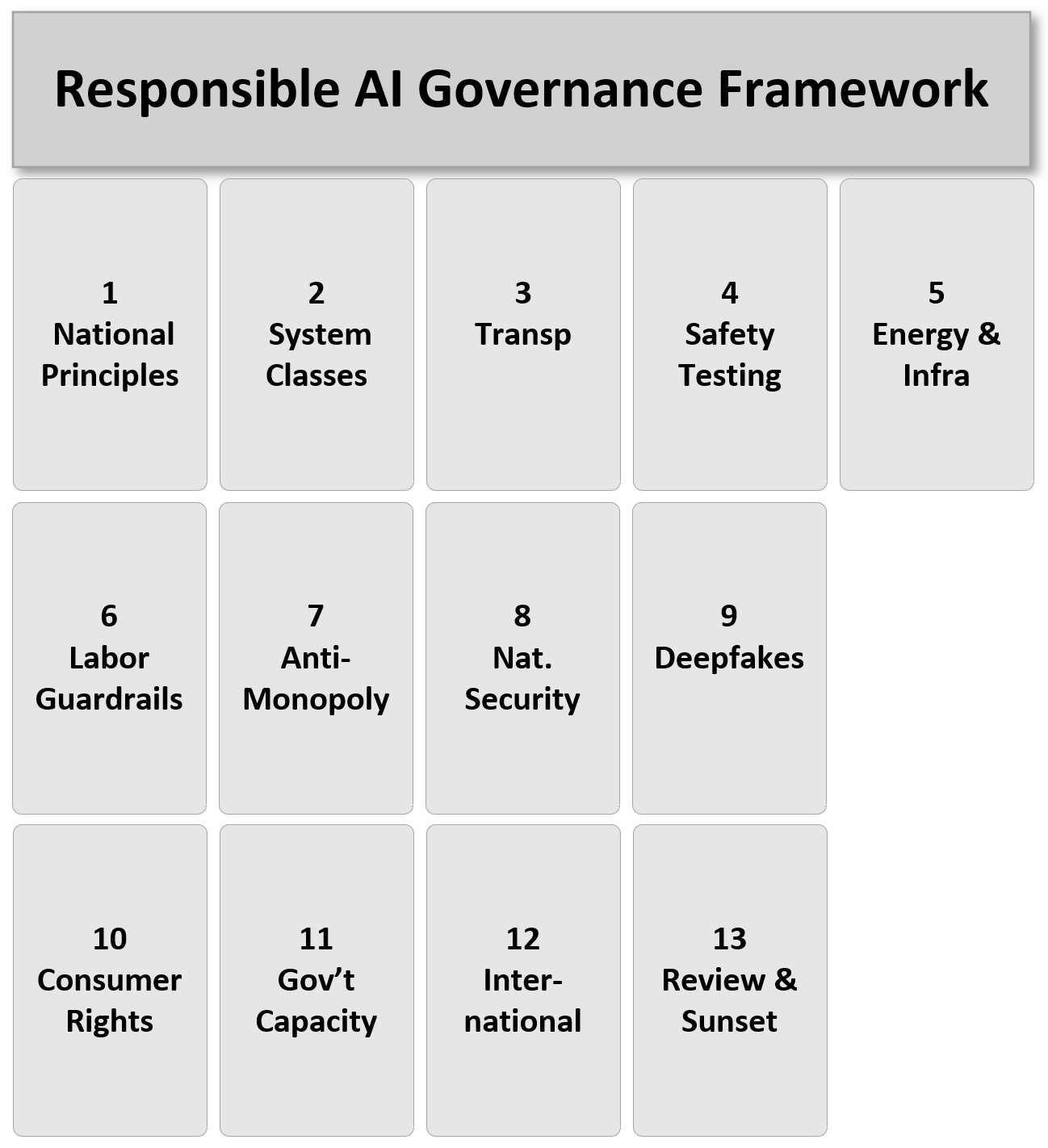
The 13-pillar diagram anchors the comparison:
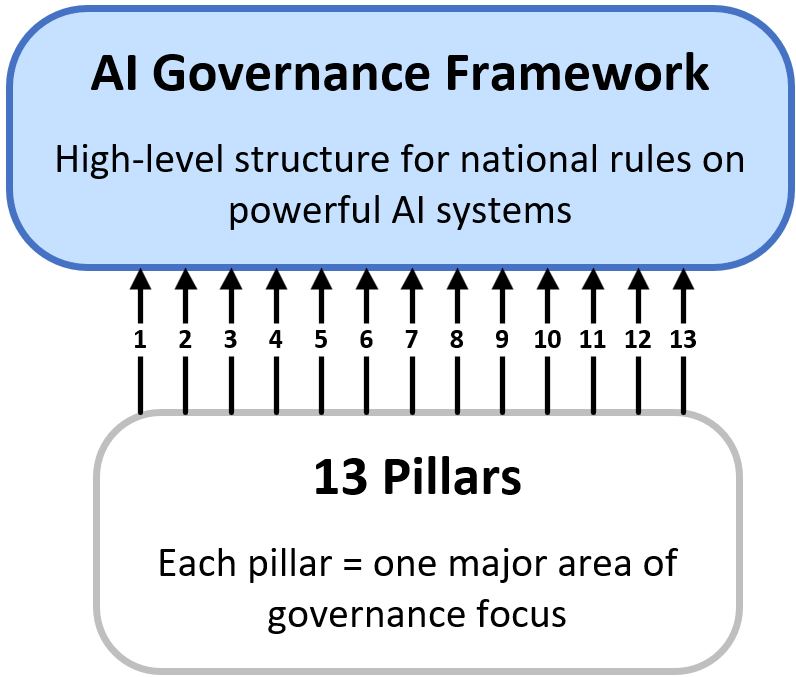
This page compares the 13-Pillar AI Governance Framework with existing U.S. and Washington State efforts. It highlights where current laws fit — and where gaps remain.
No existing U.S. or Washington State framework matches the scope or structure of the 13 pillars. Most government efforts focus on narrow areas like technical risk, civil rights, or deepfake regulation. The 13-pillar model is much broader and functions as a complete reference architecture for future AI legislation.
| Pillar | Focus | NIST RMF | WA Task Force | Federal EOs | Draft Bills |
|---|---|---|---|---|---|
| P1 | National objectives | values only | principles | high-level goals | no national charter |
| P2 | Model safety | core | standards | safety | risk bills |
| P3 | Transparency | core | reviews | reporting | accountability bills |
| P4 | Security & misuse | some | included | national security | cyber laws |
| P5 | Energy & compute | none | none | minimal | few |
| P6 | Labor & automation | none | studies | mentions | light coverage |
| P7 | Education | none | in scope | broad | scattered |
| P8 | Public-sector AI | if adopted | explicit | agency rules | procurement bills |
| P9 | Deepfakes & elections | none | weak | some | deepfake bills |
| P10 | Consumer protection | individual harm | consumer | civil rights | privacy & TAKE IT DOWN |
| P11 | Competition & power | none | none | rarely | antitrust only |
| P12 | Liability & oversight | supports | enforcement | agency powers | liability proposals |
| P13 | International standards | none | state-level | mentions allies | trade/standards |
The 13-pillar diagram anchors the comparison:
Current government efforts cover parts of pillars 2, 3, 4, 8, 9, 10, and 12. The biggest gaps are pillars 1, 5, 6, 7, 11, and 13. Your 13-pillar framework provides the missing structure — a legislative roadmap for future AI governance.
Last updated: 2025-11-30