Neoliberal AI Colonialism
How “innovation” can be built on outsourced risk: low wages, weak safety nets, and invisible workers powering AI systems.
What is AI colonialism?
“AI colonialism” is a modern form of extraction: value and control concentrate in the Global North, while the Global South is treated as a source of underpaid labor and cheap inputs needed to build and run AI.
Plain-language definition: If a system looks clean and frictionless for users in wealthy countries, but depends on hidden, precarious work elsewhere — that’s the colonial pattern resurfacing in digital form.
Neoliberal dynamics
Johns Hopkins University Press summarizes a core driver: neoliberal capitalism pushes technological innovation toward profit and efficiency, often sidelining labor rights, environmental protections, and socioeconomic justice. Deregulation and capital accumulation incentivize companies to outsource work to regions with the lowest wages and weakest social safety nets.
In the AI sector, this frequently shows up as outsourcing data labeling and content moderation to countries such as India, Kenya, and the Philippines. Reported wages can be extremely low — sometimes around $1.50 per hour — with precarious conditions and minimal protections.
AI readiness gap
The Global North tends to dominate AI “readiness” rankings — with the United States, the United Kingdom, and Germany consistently near the top — while many Global South states trail behind.
This is more than a tech gap. It reflects a systemic pattern: the Global South is often positioned as a provider of undervalued labor and low-cost inputs, rather than an equal partner in AI development and deployment.
Ghost labor and invisibility
A major human rights issue is that the people doing essential training work — tagging images, reviewing content, processing data, rating outputs — are frequently invisible in the public story of AI progress.
- Monotonous, repetitive tasks are critical to training and “aligning” AI systems.
- Workers are often bound by NDAs and layered outsourcing contracts.
- Corporate distance makes harms easier to ignore — and accountability harder to enforce.
Key phrase: “Ghost laborers” — indispensable to AI performance, absent from the celebration of AI innovation.
Case study: Oskarina Vero Fuentes
The story of Oskarina Vero Fuentes — a Venezuelan content moderator based in Colombia — illustrates the “digital sweatshop” side of the AI ecosystem. She performs data labeling tasks on platforms such as Appen, earning between 2.2 and 50 cents per task, with typical earnings described as about $1 for 1.5 hours of work.
On rare weeks when tasks are plentiful, she might reach about $280 per month, roughly aligning with Colombia’s minimum wage — but those weeks are uncommon. The excerpt describes extremely long hours and starting very early to compete for unpredictable tasks.
Similar patterns can be found across East Africa, Venezuela, India, the Philippines, and refugee communities, including large data-labeling operations such as Sama’s Nairobi office (3,000 employees), which has faced public criticism for content moderation conditions.
Governance Model
The neoliberal push towards technological innovation, profit and efficiency at the expense of Global South labor rights falls under Pillars 6 and 12 in the Responsible AI Governance Framework.
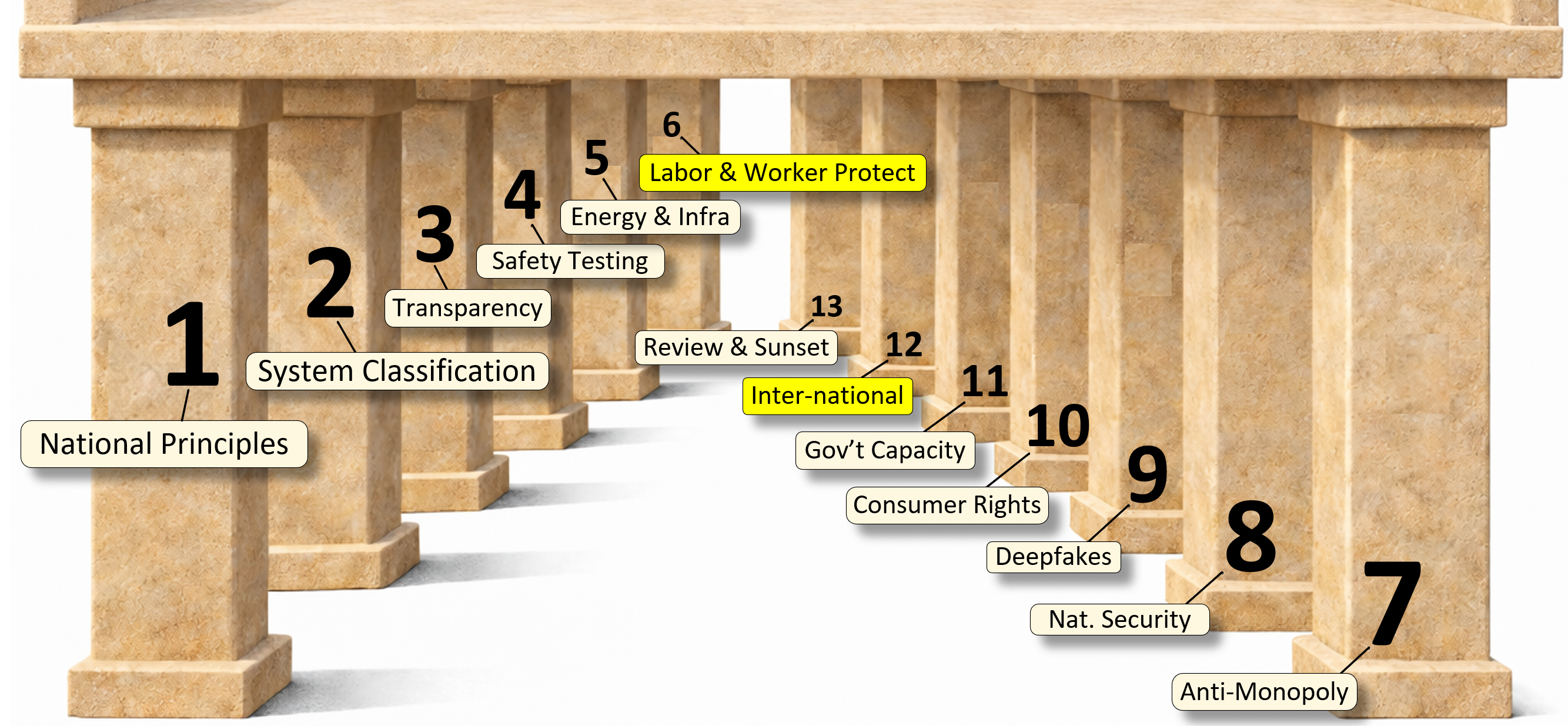
Responsible AI governance pillars relevant to Labor Protection, and International
So what?
“AI colonialism” isn’t just a critique — it’s a test of whether AI governance will protect workers and human dignity across borders, or whether the industry will keep exporting harm to the least powerful.
- For vendors: publish labor transparency reports; guarantee living wages and mental health support.
- For governments: require labor disclosures in procurement and enforce supply-chain accountability.
- For the public: ask: “Who did the hidden work — and under what conditions?”