A Microphone, a City Council, and an Unusual Set of Speakers🔗
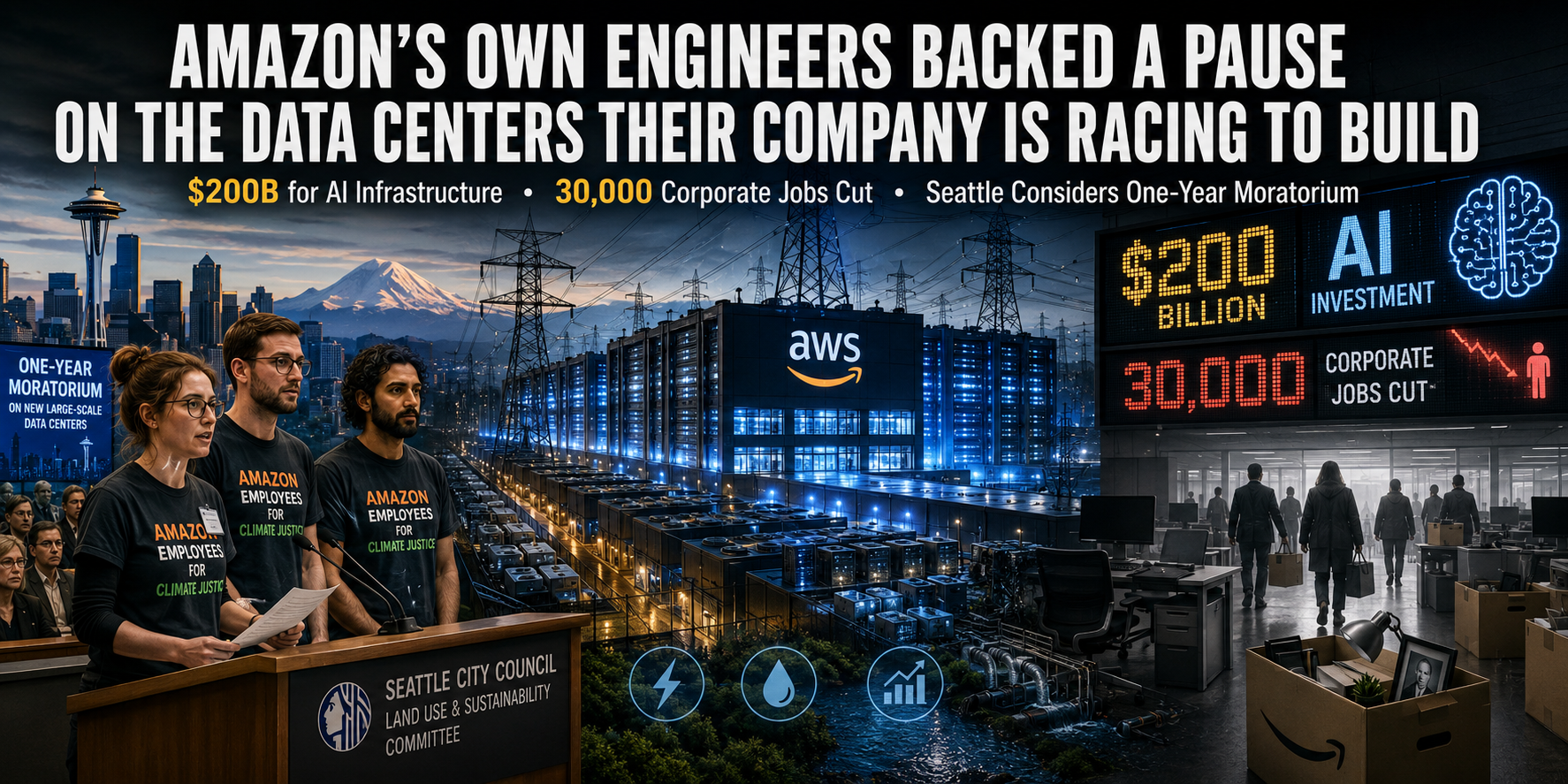
At a Seattle City Council hearing on June 3, the people stepping up to the public microphone to argue for tighter limits on artificial-intelligence data centers were not the usual neighborhood activists or environmental lobbyists. They were engineers at Amazon — the company whose AI buildout has become one of the largest in the world.
The council's Land Use and Sustainability Committee voted unanimously that day to advance a proposed one-year moratorium on new large-scale data center developments within city limits. The pause is meant to give Seattle time to study how these facilities affect the power grid, water systems, public health, and the local economy before more of them are approved. The measure now moves to the full council.
Three of the speakers — Liesl Wigand, Patrick Schloesser, and Darius Irani — are members of Amazon Employees for Climate Justice, a group of current and former workers that has spent years pressing the company on its environmental and labor record. Their appearance turned a routine land-use vote into something rarer: employees of a hyperscaler publicly asking a local government to slow the very expansion their employer is funding.
$200 Billion for Machines, Thirty Thousand Fewer People🔗
The argument the engineers brought to the council was less about zoning than about priorities. Patrick Schloesser, who has worked at Amazon Web Services for nearly six years, drew a direct line between the company's spending and its shrinking headcount. He told officials that Amazon plans to spend about $200 billion on capital this year, with most of it going toward data centers and AI, even as leadership has eliminated roughly 30,000 corporate positions over the preceding eight months.
To Schloesser, the gap between those two numbers said something about the industry's mindset. The scale and speed of the spending, he argued, reflected an urgent race to build as much computing capacity as possible, as quickly as possible — a race in which existing employees were proving easier to cut than the infrastructure budget. The layoffs he cited are part of Chief Executive Andy Jassy's broader effort to strip out management layers and reduce what he has described as bureaucracy.
"What that tells me is that Big Tech is desperate to build as much compute capacity as it can, as fast as it can."
— Patrick Schloesser, AWS software engineer, at the Seattle City Council hearing (via CNBC)Why a City Wants Time to Look Before It Builds🔗
Behind the moratorium is a set of concerns that have become familiar in communities near large data centers. The facilities draw heavily on electricity and water, with the biggest sites capable of consuming several million gallons of water a day. As demand climbs, residents and local officials have increasingly worried about strain on shared infrastructure and the prospect of higher utility bills passed along to ordinary ratepayers.
Seattle has already seen that pressure firsthand. Four developers had proposed five new mega data centers to the region's utility provider; after public opposition, two of those proposals were withdrawn. The one-year pause is framed not as a permanent rejection of the technology but as a chance to write rules — on energy sourcing, water use, and oversight — before the next wave of construction locks the city into commitments it has not fully examined.
Seattle is not acting in isolation. The National Conference of State Legislatures counts 14 states weighing measures that would pause, restrict, or add conditions to new data center projects. Data Center Watch has tallied more than $156 billion in projects delayed or canceled in 2025 amid local opposition and litigation.
Yet the largest companies show no sign of slowing. Amazon, Microsoft, Alphabet, and Meta have together committed roughly $700 billion in capital expenditures this year, overwhelmingly for AI infrastructure — even as several of them pursue cost cuts that include layoffs.
A Question the Whole Industry Is Now Facing🔗
The Seattle hearing put a local face on a national tension. The build-out of AI infrastructure is among the largest capital projects in modern corporate history, and its benefits — faster models, more cloud capacity, market position — accrue mostly to the companies and their shareholders. The costs, by contrast, land in specific places: on the grids, watersheds, and utility bills of the communities where the buildings actually go.
What made the Amazon engineers' testimony notable was that it connected those local costs to a labor question usually kept separate from them. If a company can find $200 billion for machines in a single year, they asked in effect, what does it mean that it cannot find room for the workers it is letting go? That framing — capital versus labor, infrastructure versus people — is now being raised not only by outside critics but from inside the firms doing the building.
The Seattle moratorium still has to clear the full council, and a one-year pause in a single city will not slow a $700 billion industry trend on its own. But the spectacle of a company's own employees lobbying their local government to regulate their employer's growth is a sign of how contested the AI build-out has become — and of how many different communities are now asking who, exactly, the boom is for.