The Day Micron Crossed a Trillion
On the morning of May 26, 2026, Wall Street woke up to a note from UBS analyst Timothy Arcuri that did something almost unheard of on the Street: it tripled a price target. Arcuri raised his outlook on Micron Technology from $535 to $1,625 per share — the highest target among the 46 brokerages that cover the company. By the close, Micron shares had surged roughly 19%, pushing the company's market capitalization past one trillion dollars for the first time in its forty-year history.
The following morning — captured by the CNBC cameras and visible on televisions across the country — the Squawk on the Street anchors were still processing it. They had the numbers right. What seemed to elude the conversation was the underlying logic: why now, why this fast, and why should investors believe the move is durable rather than speculative froth riding an AI wave?
The short answer is that Micron is no longer a commodity memory chip company in any meaningful sense. It has quietly become one of the two or three most critical suppliers in the entire artificial intelligence infrastructure stack — and the market is only now catching up to what that means.
What HBM Is, and Why Every AI System Needs It
To understand Micron's sudden elevation, it helps to understand a piece of hardware most people have never heard of: high-bandwidth memory, or HBM. These are specialized chips that sit directly adjacent to AI processors — the GPUs made by Nvidia and others — feeding them data fast enough to keep up with the immense computational demands of running large language models and other AI workloads.
Conventional memory — the kind found in laptops and smartphones — cannot transfer data quickly enough to prevent bottlenecks in AI processing. HBM solves that problem through a stacked, three-dimensional architecture that dramatically increases the bandwidth between memory and processor. Without sufficient HBM, even the most powerful AI chip underperforms. The GPU is the brain; HBM is the nervous system through which information flows.
Micron is one of only three companies in the world capable of manufacturing HBM at scale, alongside Samsung and SK Hynix. In the current generation, Micron's HBM4 product has become the preferred specification for several major cloud providers. And according to CEO Sanjay Mehrotra, the company is currently fulfilling just 50 to 65 percent of its key customers' medium-term demand. Its entire 2026 production capacity is already sold out.
"There is no clear line of sight on when the supply-demand imbalance could end."— Vijay Rakesh, Mizuho analyst, May 26, 2026
The UBS Upgrade That Moved $160 Billion in a Day
UBS analyst Timothy Arcuri, consistently ranked among the top five semiconductor analysts on Wall Street, framed his upgrade around a structural argument, not a near-term earnings beat. His thesis was that Micron's business model is undergoing a transformation that the market has not yet fully priced. Long-term supply agreements — with partially fixed pricing — are replacing the volatile, spot-market dynamics that historically made memory stocks difficult to own. AI customers are not haggling over HBM prices. They are locking in supply years in advance, at whatever it costs, because the alternative is falling behind in the AI race.
That shift from commodity pricing to contract pricing changes everything about how Micron should be valued. Arcuri wrote that the market would begin applying a more normal earnings multiple to the stock as these structural changes became better understood. In perhaps the most striking line of the note, he suggested there was "no reason why MU should trade a whole lot differently than Nvidia in terms of P/E." Even at its current elevated price, Micron trades at roughly 8.4 times forward earnings — well below Nvidia and well below the broader semiconductor sector. That gap is the bull case in a single number.
| Metric | Current (May 27) | One Year Ago |
|---|---|---|
| MU Share Price | $963.63 | ~$140 |
| Market Cap | ~$1.07 Trillion | ~$155 Billion |
| Gross Margin | 46.7% | ~35% |
| Quarterly HBM Revenue | ~$2 Billion | Negligible |
| UBS Price Target | $1,625 | $535 |
Why the CNBC Anchors Seemed Puzzled
Financial television is structurally oriented toward explaining the present through the lens of the recent past. For most of Micron's forty-year history, covering the company meant tracking DRAM pricing cycles, inventory gluts, and the quarterly roller coaster of a business that sold largely undifferentiated product into a global commodity market. That history created a pattern of analysis — watch the cycle, buy the trough, sell the peak — that worked reliably enough to become ingrained.
That framework is now the wrong tool. The AI buildout has introduced something the memory industry has never seen before: customers who are structurally price-insensitive. Microsoft, Google, Amazon, and Meta are each committing hundreds of billions of dollars to AI data center infrastructure. Within those programs, HBM is not a discretionary purchase that gets cut when prices rise. It is a requirement without a substitute. Customers are reportedly booking Micron's 2028 production today.
The confusion on-screen is not a failure of intelligence. It is the predictable result of analytical frameworks encountering a market structure they were not built to interpret. The memory business that television learned to cover no longer exists in its familiar form.
The Infrastructure Stack Behind Every AI Query
When someone runs a query through ChatGPT, Claude, Gemini, or any major AI system, the request travels to a data center where it is processed by racks of GPU clusters. Each GPU cluster requires high-bandwidth memory to function at full speed. A single Nvidia H100 server rack — the current standard for AI training — consumes more HBM than several generations of consumer electronics combined. As cloud providers scale from thousands of GPUs to hundreds of thousands, the demand curve for HBM becomes nearly vertical. Micron, Samsung, and SK Hynix collectively cannot produce enough of it. Micron alone is the most exposed to the U.S. market and carries the most direct relationship with the major American AI labs and cloud providers.
Micron Is Not Alone — The $1T Club Is Now Essentially an AI Club
The CNBC segment that followed Micron's milestone broadcast a graphic that deserves to be read as carefully as any earnings report. It showed the complete list of U.S.-listed companies now worth more than one trillion dollars: Alphabet, Amazon, Meta, Nvidia, Broadcom, Tesla, Apple, Micron, Berkshire Hathaway, Microsoft, and TSMC. The full global club — which also includes Samsung, SK Hynix, and Saudi Aramco — has grown to fourteen members. Together, their combined market capitalizations total roughly $35 trillion, a figure that now slightly exceeds America's entire gross domestic product.
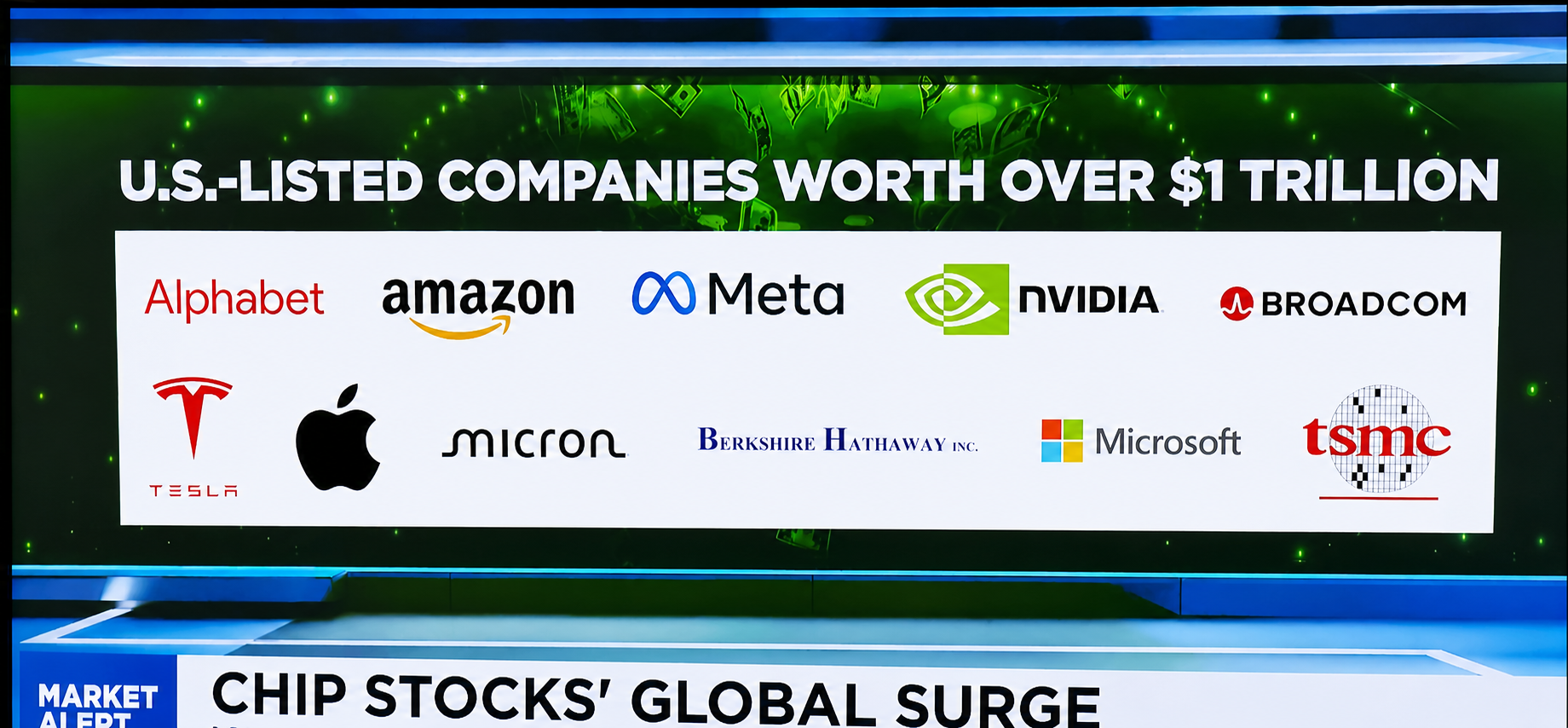
What the graphic makes visually undeniable is something analysts have been saying in research notes for months: the AI wave is not a story about one company, one sector, or one product cycle. Of the fourteen members of the global trillion-dollar club, only two — Berkshire Hathaway and Saudi Aramco — operate largely outside the AI economy. Every other member is either building the infrastructure AI runs on, supplying the components that infrastructure requires, or deploying AI at massive scale to drive revenue growth.
The pattern inside the graphic is striking. The hyper-scalers — Microsoft, Amazon, Alphabet, and Meta — are spending collectively more than $300 billion on AI data center infrastructure in 2026. That spending flows directly to the infrastructure layer: Nvidia for GPUs, TSMC for advanced chip fabrication, Broadcom for custom AI silicon and networking, and Micron and its memory peers for HBM. The trillion-dollar valuations at the top of the tech pyramid are essentially funding the trillion-dollar valuations of the suppliers beneath them. AI is not one company's story. It is a coordinated, capital-intensive buildout that is reshaping the entire valuation landscape of the stock market.
That context reframes Micron's surge entirely. It was not an anomaly. It was the market recognizing, belatedly, that the last critical link in the AI infrastructure chain had been left undervalued while everything around it re-rated. The memory chip supplier connecting the world's most powerful processors to the world's fastest-growing workload was still trading like a commodity business in a down cycle. That disconnect closed in a single trading session.
A Structural Shift, Not a Speculative Spike
More than 2,400 institutional investors opened new positions in Micron during the first quarter of 2026 alone, according to regulatory filings. These are not day traders chasing momentum. They are sovereign wealth funds, pension managers, and major asset management firms making long-duration bets on the proposition that AI infrastructure spending is durable, that HBM is irreplaceable, and that Micron's improved margins reflect a genuine change in pricing power rather than a temporary tightness.
Micron's gross margins tell part of the story on their own terms. At 46.7% in the most recent quarter, they are running twelve percentage points higher than a year ago — and this is happening while the company is simultaneously investing heavily in new fabrication capacity. That combination, expanding margins alongside rising capital expenditure, is not typical of a commodity business in a normal upcycle. It is the signature of a company that has moved into a position of structural leverage over its customers.
None of this means the stock is without risk. The HBM shortage will eventually attract more supply. Competitors are building capacity. Geopolitical dynamics — particularly around U.S.-China trade and Taiwan — create persistent uncertainty across the semiconductor sector. And any significant slowdown in cloud provider spending on AI infrastructure would ripple through Micron's order book quickly.
But the core insight that the UBS note captured — and that the morning shows struggled to articulate — is that the memory business has been permanently altered by AI. The question is not whether Micron's current valuation is justified by last year's earnings model. The question is what the company looks like when it has sold out two, three, or four more years of HBM capacity at structurally higher prices. On that basis, the conversation on television that morning was looking at the right numbers and asking the wrong question.
"Every major cloud provider is racing to build AI data center capacity. Each of those facilities requires enormous quantities of HBM. And right now, Micron can't make them fast enough."— UBS Research Note, May 26, 2026
This Is Analysis, Not Investment Advice
The discussion above is editorial analysis of publicly available market information. Nothing here constitutes a recommendation to buy, sell, or hold any security. Micron's stock has gained dramatically in a short period; past performance does not predict future results. Anyone making investment decisions should consult a qualified financial advisor and conduct their own due diligence.