Scanned first pages (as images). If you store images elsewhere, update the src paths below.
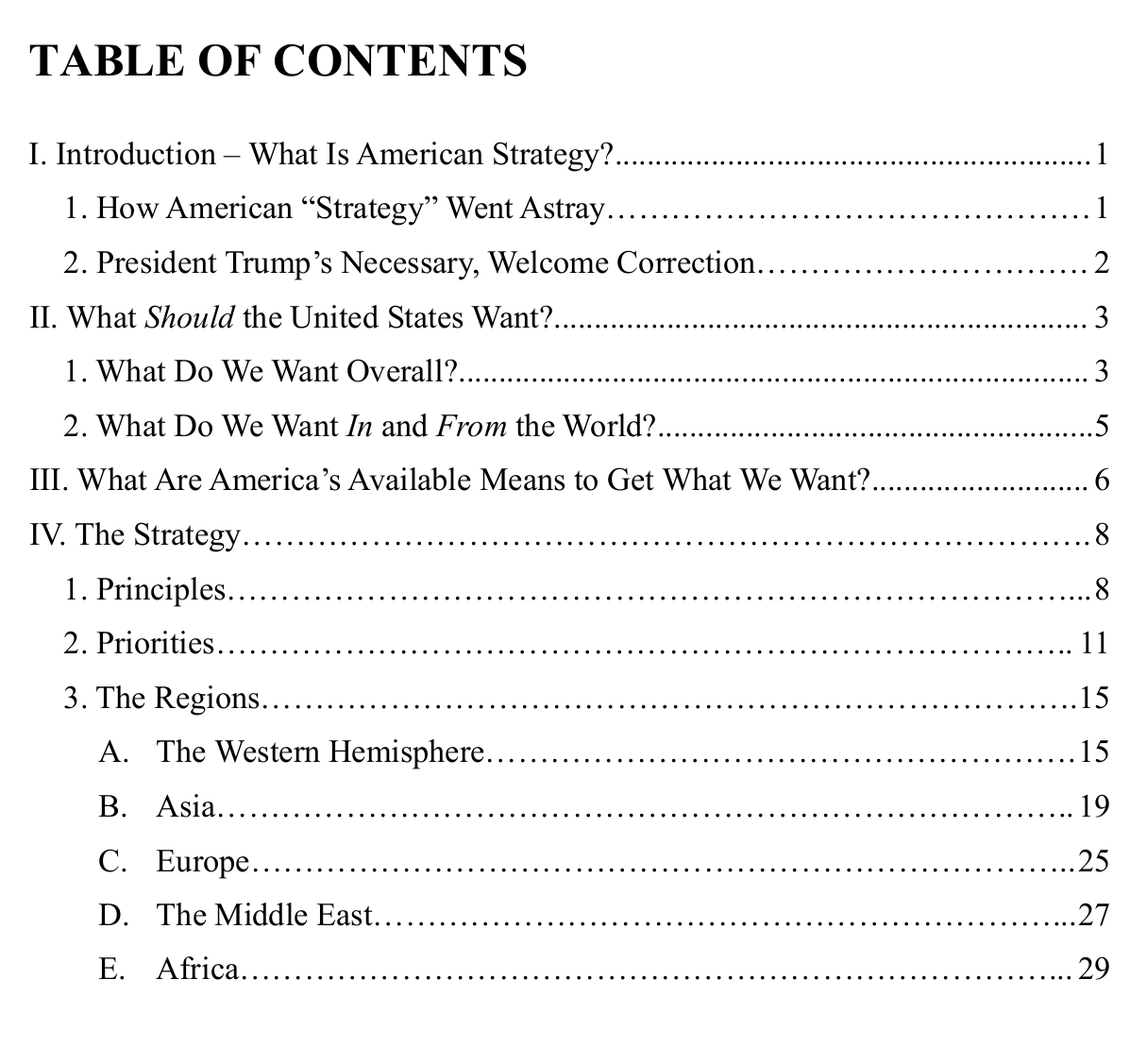
Contents
I. Introduction — What Is American Strategy?
1. How American “Strategy” Went Astray
To ensure that America remains the world’s strongest, richest, most powerful, and most successful country for decades to come, our country needs a coherent, focused strategy for how we interact with the world. And to get that right, all Americans need to know what, exactly, it is we are trying to do and why.
A “strategy” is a concrete, realistic plan that explains the essential connection between ends and means: it begins from an accurate assessment of what is desired and what tools are available, or can realistically be created, to achieve the desired outcomes.
A strategy must evaluate, sort, and prioritize. Not every country, region, issue, or cause—however worthy—can be the focus of American strategy. The purpose of foreign policy is the protection of core national interests; that is the sole focus of this strategy.
American strategies since the end of the Cold War have fallen short—they have been laundry lists of wishes or desired end states; have not clearly defined what we want but instead stated vague platitudes; and have often misjudged what we should want.
After the end of the Cold War, American foreign policy elites convinced themselves that permanent American domination of the entire world was in the best interests of our country. Yet the affairs of other countries are our concern only if their activities directly threaten our interests.
Our elites badly miscalculated America’s willingness to shoulder forever global burdens to which the American people saw no connection to the national interest. They overestimated America’s ability to fund, simultaneously, a massive welfare-regulatory-administrative state alongside a massive military, diplomatic, intelligence, and foreign aid complex. They placed hugely misguided and destructive bets on globalism and so-called “free trade” that hollowed out the very middle class and industrial base on which American economic and military preeminence depend. They allowed allies and partners to offload the cost of their defense onto the American people, and sometimes to suck us into conflicts and controversies central to their interests but peripheral or irrelevant to our own. And they lashed American policy to a network of international institutions, some of which are driven by outright anti-Americanism and many by a transnationalism that explicitly seeks to dissolve individual state sovereignty.
In sum, not only did our elites pursue a fundamentally undesirable and impossible goal, in doing so they undermined the very means necessary to achieve that goal: the character of our nation upon which its power, wealth, and decency were built.
2. President Trump’s Necessary, Welcome Correction
None of this was inevitable. President Trump’s first administration proved that with the right leadership making the right choices, all of the above could—and should—have been avoided, and much else achieved. He and his team successfully marshaled America’s great strengths to correct course and begin ushering in a new golden age for our country. To continue the United States on that path is the overarching purpose of President Trump’s second administration, and of this document.
The questions before us now are: 1) What should the United States want? 2) What are our available means to get it? and 3) How can we connect ends and means into a viable National Security Strategy?
II. What Should the United States Want?
1. What Do We Want Overall?
First and foremost, we want the continued survival and safety of the United States as an independent, sovereign republic whose government secures the God-given natural rights of its citizens and prioritizes their well-being and interests.
We want to protect this country, its people, its territory, its economy, and its way of life from military attack and hostile foreign influence, whether espionage, predatory trade practices, drug and human trafficking, destructive propaganda and influence operations, cultural subversion, or any other threat to our nation.
We want full control over our borders, over our immigration system, and over transportation networks through which people come into our country—legally and illegally. We want a world in which migration is not merely “orderly” but one in which sovereign countries work together to stop rather than facilitate destabilizing population flows, and have full control over whom they do and do not admit.
We want a resilient national infrastructure that can withstand natural disasters, resist and thwart foreign threats, and prevent or mitigate any events that might harm the American people or disrupt the American economy. No adversary or danger should be able to hold America at risk.
We want to recruit, train, equip, and field the world’s most powerful, lethal, and technologically advanced military to protect our interests, deter wars, and—if necessary—win them quickly and decisively, with the lowest possible casualties to our forces. And we want a military in which every single servicemember is proud of their country and confident in their mission.
We want the world’s most robust, credible, and modern nuclear deterrent, plus next-generation missile defenses—including a Golden Dome for the American homeland—to protect the American people, American assets overseas, and American allies.
We want the world’s strongest, most dynamic, most innovative, and most advanced economy. The U.S. economy is the bedrock of the American way of life, which promises and delivers widespread and broad-based prosperity, creates upward mobility, and rewards hard work. Our economy is also the bedrock of our global position and the necessary foundation of our military.
We want the world’s most robust industrial base. American national power depends on a strong industrial sector capable of meeting both peacetime and wartime production demands. That requires not only direct defense industrial production capacity but also defense-related production capacity. Cultivating American industrial strength must become the highest priority of national economic policy.
We want the world’s most robust, productive, and innovative energy sector—one capable not just of fueling American economic growth but of being one of America’s leading export industries in its own right.
We want to remain the world’s most scientifically and technologically advanced and innovative country, and to build on these strengths. And we want to protect our intellectual property from foreign theft. America’s pioneering spirit is a key pillar of our continued economic dominance and military superiority; it must be preserved.
We want to maintain the United States’ unrivaled “soft power” through which we exercise positive influence throughout the world that furthers our interests. In doing so, we will be unapologetic about our country’s past and present while respectful of other countries’ differing religions, cultures, and governing systems. “Soft power” that serves America’s true national interest is effective only if we believe in our country’s inherent greatness and decency.
Finally, we want the restoration and reinvigoration of American spiritual and cultural health, without which long-term security is impossible. We want an America that cherishes its past glories and its heroes, and that looks forward to a new golden age. We want a people who are proud, happy, and optimistic that they will leave their country to the next generation better than they found it. We want a gainfully employed citizenry—with no one sitting on the sidelines—who take satisfaction from knowing that their work is essential to the prosperity of our nation and to the well-being of individuals and families. This cannot be accomplished without growing numbers of strong, traditional families that raise healthy children.
2. What Do We Want In and From the World?
Achieving these goals requires marshaling every resource of our national power. Yet this strategy’s focus is foreign policy. What are America’s core foreign policy interests? What do we want in and from the world?
- We want to ensure that the Western Hemisphere remains reasonably stable and well-governed enough to prevent and discourage mass migration to the United States; we want a Hemisphere whose governments cooperate with us against narco-terrorists, cartels, and other transnational criminal organizations; we want a Hemisphere that remains free of hostile foreign incursion or ownership of key assets, and that supports critical supply chains; and we want to ensure our continued access to key strategic locations. In other words, we will assert and enforce a “Trump Corollary” to the Monroe Doctrine;
- We want to halt and reverse the ongoing damage that foreign actors inflict on the American economy while keeping the Indo-Pacific free and open, preserving freedom of navigation in all crucial sea lanes, and maintaining secure and reliable supply chains and access to critical materials;
- We want to support our allies in preserving the freedom and security of Europe, while restoring Europe’s civilizational self-confidence and Western identity;
- We want to prevent an adversarial power from dominating the Middle East, its oil and gas supplies, and the chokepoints through which they pass while avoiding the “forever wars” that bogged us down in that region at great cost; and
- We want to ensure that U.S. technology and U.S. standards—particularly in AI, biotech, and quantum computing—drive the world forward.
These are the United States’ core, vital national interests. While we also have others, these are the interests we must focus on above all others, and that we ignore or neglect at our peril.
III. What Are America’s Available Means to Get What We Want?
America retains the world’s most enviable position, with world-leading assets, resources, and advantages, including:
- A still nimble political system that can course correct;
- The world’s single largest and most innovative economy, which both generates wealth we can invest in strategic interests and provides leverage over countries that want access to our markets;
- The world’s leading financial system and capital markets, including the dollar’s global reserve currency status;
- The world’s most advanced, most innovative, and most profitable technology sector, which undergirds our economy, provides a qualitative edge to our military, and strengthens our global influence;
- The world’s most powerful and capable military;
- A broad network of alliances, with treaty allies and partners in the world’s most strategically important regions;
- An enviable geography with abundant natural resources, no competing powers physically dominant in our Hemisphere, borders at no risk of military invasion, and other great powers separated by vast oceans;
- Unmatched “soft power” and cultural influence; and
- The courage, willpower, and patriotism of the American people.
In addition, through President Trump’s robust domestic agenda, the United States is:
- Re-instilling a culture of competence, rooting out so-called “DEI” and other discriminatory and anti-competitive practices that degrade our institutions and hold us back;
- Unleashing our enormous energy production capacity as a strategic priority to fuel growth and innovation, and to bolster and rebuild the middle class;
- Reindustrializing our economy, again to further support the middle class and control our own supply chains and production capacities;
- Returning economic freedom to our citizens via historic tax cuts and deregulatory efforts, making the United States the premier place to do business and invest capital; and
- Investing in emerging technologies and basic science, to ensure our continued prosperity, competitive advantage, and military dominance for future generations.
The goal of this strategy is to tie together all of these world-leading assets, and others, to strengthen American power and preeminence and make our country even greater than it ever has been.
IV. The Strategy
1. Principles
President Trump’s foreign policy is pragmatic without being “pragmatist,” realistic without being “realist,” principled without being “idealistic,” muscular without being “hawkish,” and restrained without being “dovish.” It is not grounded in traditional, political ideology. It is motivated above all by what works for America—or, in two words, “America First.”
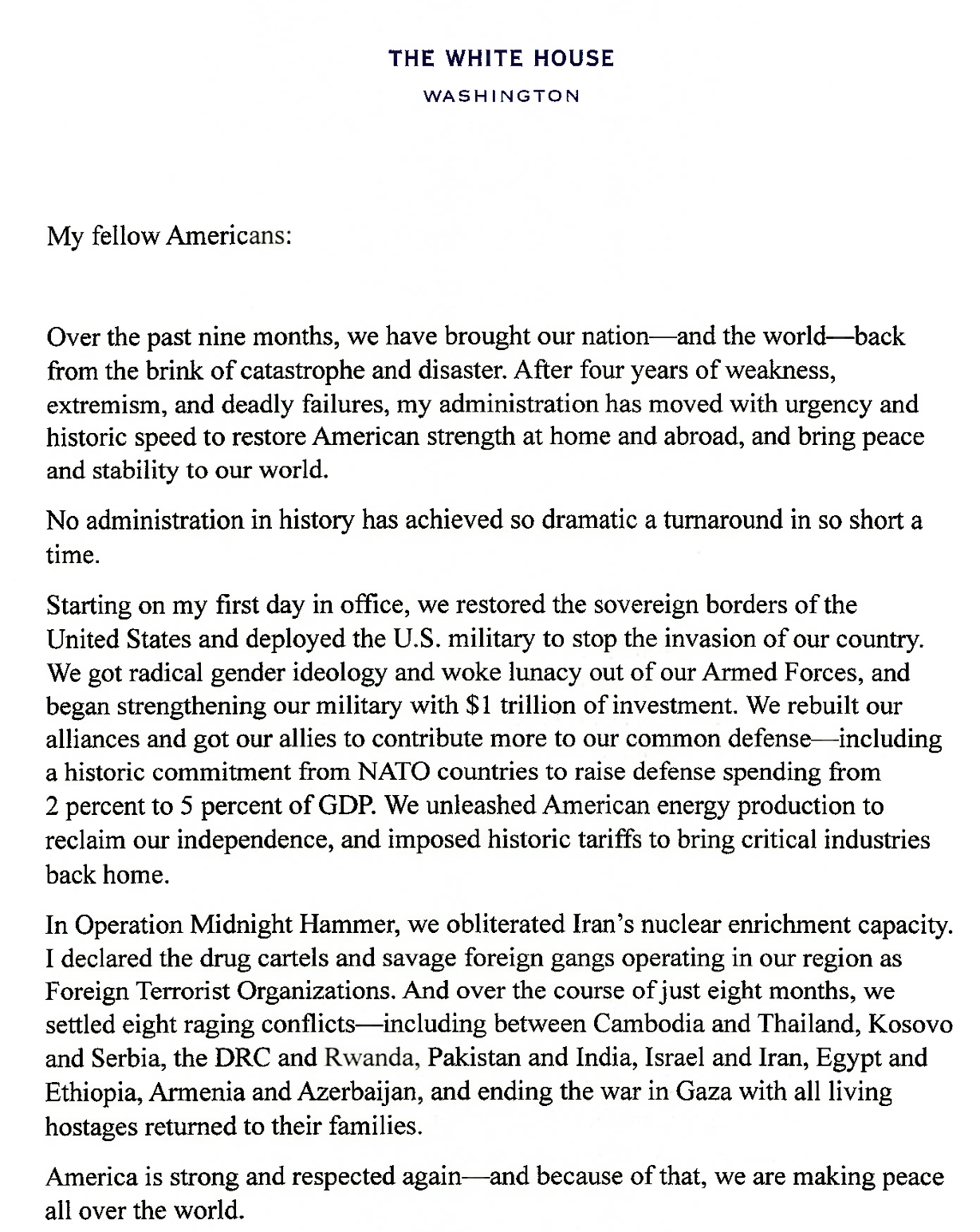
President Trump has cemented his legacy as The President of Peace. In addition to the remarkable success achieved during his first term with the historic Abraham Accords, President Trump has leveraged his dealmaking ability to secure unprecedented peace in eight conflicts throughout the world over the course of just eight months of his second term. He negotiated peace between Cambodia and Thailand, Kosovo and Serbia, the DRC and Rwanda, Pakistan and India, Israel and Iran, Egypt and Ethiopia, Armenia and Azerbaijan, and ended the war in Gaza with all living hostages returned to their families.
Stopping regional conflicts before they spiral into global wars that drag down whole continents is worthy of the Commander-in-Chief’s attention, and a priority for this administration. A world on fire, where wars come to our shores, is bad for American interests.
President Trump uses unconventional diplomacy, America’s military might, and economic leverage to surgically extinguish embers of division between nuclear-capable nations and violent wars caused by centuries-long hatred.
- Focused Definition of the National Interest — America’s core national security interests shall be our focus.
- Peace Through Strength — Strength is the best deterrent, and enables peace.
- Predisposition to Non-Interventionism — A high bar for intervention while recognizing rigid adherence is not always possible.
- Flexible Realism — Seek good relations without imposing social change on other nations.
- Primacy of Nations — The nation-state remains fundamental; sovereignty should be guarded.
- Sovereignty and Respect — Protect U.S. sovereignty against outside interference and manipulation.
- Balance of Power — Prevent any nation from becoming dominant enough to threaten U.S. interests.
- Pro-American Worker — Pro-worker policy prioritizing American workers and broadly shared prosperity.
- Fairness — Insist on fair treatment in alliances, trade, and burden-sharing.
- Competence and Merit — Promote competence and merit; oppose systems that undermine them.
2. Priorities
- The Era of Mass Migration Is Over — Border security as primary element of national security.
- Protection of Core Rights and Liberties — Guard free speech, religion, conscience, and democratic choice.
- Burden-Sharing and Burden-Shifting — Allies must assume greater responsibility; NATO 5% GDP commitment cited.
- Realignment Through Peace — Peace deals as a method to increase stability and influence.
- Economic Security — Balanced trade; critical supply chains; reindustrialization; defense industrial base; energy dominance; financial sector dominance.
3. The Regions
To focus and prioritize is to choose—to acknowledge that not everything matters equally, to everyone. It is not to assert that any peoples, regions, or countries are somehow intrinsically unimportant.
A. Western Hemisphere: The Trump Corollary to the Monroe Doctrine
After years of neglect, the United States will reassert and enforce the Monroe Doctrine to restore American preeminence in the Western Hemisphere.
Our goals for the Western Hemisphere can be summarized as “Enlist and Expand.”
B. Asia: Win the Economic Future, Prevent Military Confrontation
The Indo-Pacific is described as a key economic and geopolitical battleground. The strategy emphasizes rebalancing economic relations with China, securing supply chains, and strengthening deterrence to prevent war.
C. Promoting European Greatness
The document argues Europe faces deep challenges including economic decline, migration, censorship, low birthrates, and “civilizational erasure,” and states a U.S. goal to help Europe “correct its current trajectory.”
D. The Middle East: Shift Burdens, Build Peace
The strategy describes reduced U.S. dependence on Middle East energy, continued core interests (sea lanes, anti-terror, Israel security), and a preference to avoid “forever wars,” emphasizing partnerships and investment.
E. Africa
The strategy calls for transitioning from an aid-focused approach to trade- and investment-focused relationships, with attention to energy and critical minerals, while remaining wary of terrorist activity.