

What Two Researchers Walked Away From — and Why
Liam Fedus was, by any measure, at the top of his field. As VP of Research at OpenAI, he was part of the small team that built ChatGPT — the product that arguably launched the modern era of public AI. He left in early 2025. Around the same time, Ekin Dogus Cubuk departed Google DeepMind, where he had led the materials and chemistry research team that used AI to discover more than 2.2 million previously unknown inorganic crystal structures — roughly 800 years' worth of human scientific output compressed into a single project.
The two had met while both were at Google, and what drew them together was a shared conviction: that the AI industry, for all its momentum, had taken a wrong turn. The dominant strategy at every major lab was to feed larger models more text from the internet and measure how well the systems could predict what came next. That approach had produced tools of genuine usefulness. But Fedus and Cubuk did not believe it would produce scientific discovery in any deep sense. They started Periodic Labs.
Mark Zuckerberg personally invited one of the researchers who eventually joined Periodic — Rishabh Agarwal, already a Meta employee — to join Meta's new superintelligence lab, offering millions in stock and salary. Agarwal declined, along with more than 20 other researchers from OpenAI, Google DeepMind, and Meta who gave up tens of millions, in some cases hundreds of millions, in unvested compensation to join a startup that had not yet shipped a single product.
The exodus was striking enough to draw wide attention in the industry. It reflected something beyond compensation math. The researchers who left were making a statement about what they thought mattered — and what they thought the largest AI labs were getting wrong.
Why Chatbots Alone Cannot Do Real Science
The argument that Fedus and Cubuk are making is not that large language models are useless. It is that they have a structural limitation when it comes to scientific discovery specifically. Every major AI system today was trained on text — on books, papers, websites, and code that humans had already produced. That corpus, vast as it is, has a ceiling. The internet contains roughly ten trillion tokens of data. Once a model has learned what can be learned from that material, it is essentially reciting and recombining what humanity already knows.
Science, as a practice, does not work by recombination. It works by confronting the unknown. A chemist does not discover a new superconductor by reading papers about superconductors. She forms a hypothesis, mixes specific compounds, heats them to specific temperatures, measures the results, and iterates — perhaps thousands of times — until something unexpected happens. The discovery lives in the gap between what the literature predicted and what the experiment actually produced.
"The main objective of AI is not to automate white-collar work. The main objective is to accelerate science."— Liam Fedus, Co-founder, Periodic Labs
A chatbot, Cubuk has argued, cannot make that kind of discovery by reasoning alone. It cannot sit and think its way to an unknown crystal structure any more than a human could. "Humans can't do that, either," he said. "They run many trial experiments before they find something incredible — if they even do." The implication is that any AI system meant to genuinely expand scientific knowledge has to be embedded in a cycle of physical experimentation, not just inference over existing text.
Fedus was pointed in his assessment of how Silicon Valley's leading labs have described their scientific ambitions. The claim that large language models are already pushing toward breakthroughs in drug discovery, physics, and mathematics is, in his view, intellectually lazy. He invoked the memory of Bell Labs and IBM Research — institutions that treated the physical sciences not as an application layer for computing, but as the core mission. Periodic Labs is, in his framing, an attempt to revive that model.
A Closed Loop: AI Conjectures, Robots Test, Models Learn
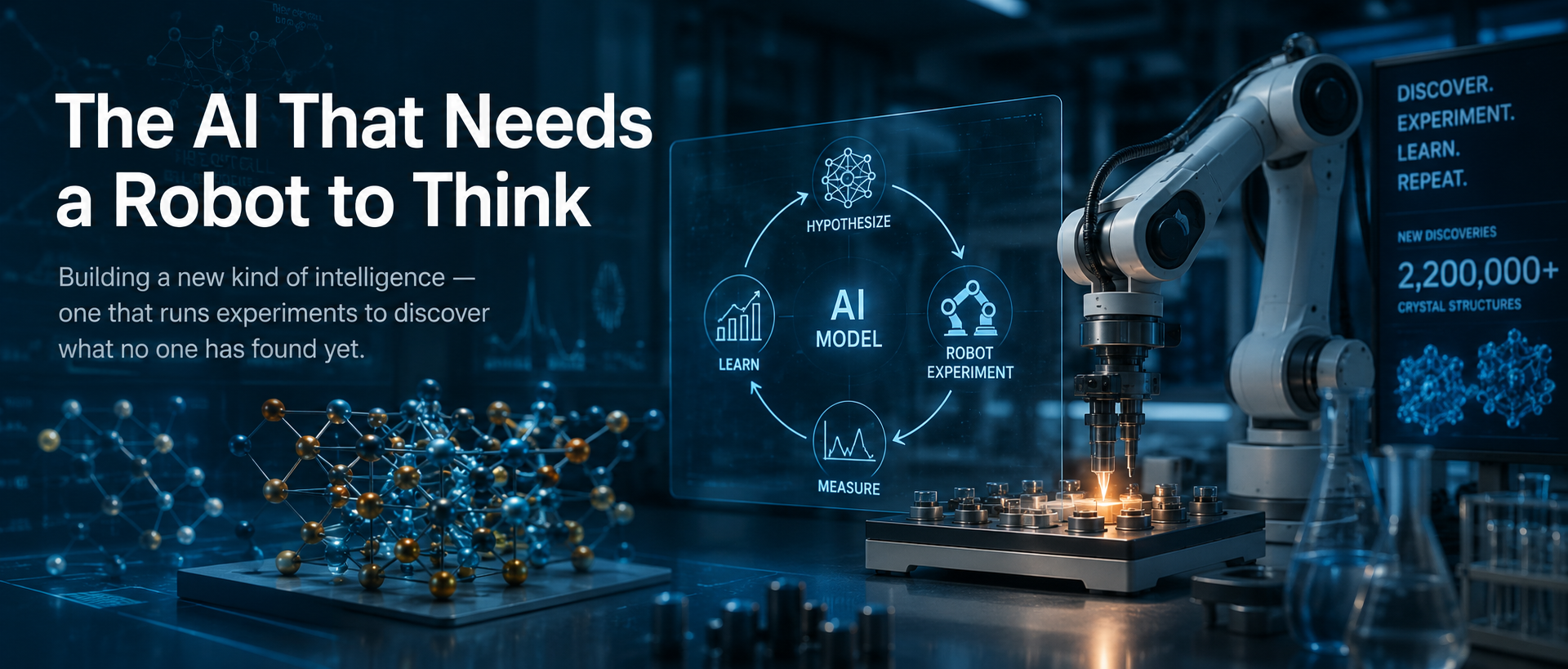
The architecture Periodic Labs is building can be described as a closed experimental loop. An AI system surveys the existing scientific literature and forms a hypothesis — a specific prediction about which combination of materials might produce a desired property, such as high-temperature superconductivity. That hypothesis is then handed to a robotic system in a physical laboratory, which carries out the actual experiment: selecting powders, mixing compounds, heating them in a furnace, and measuring the results with analytical instruments. The outcome — whether the experiment succeeded, partially succeeded, or failed — is fed back to the AI, which updates its model of the problem and generates the next hypothesis.
The key insight is that this loop generates data that does not exist anywhere else. Unlike the internet, which is finite and increasingly well-scraped, physical experiments produce genuinely novel signal. Every run of every experiment is new information about how the physical world actually behaves. An AI trained on thousands of these experimental cycles is learning from a source that no prior model has had access to.
Periodic Labs has identified superconducting materials as its initial focus. A room-temperature superconductor — a material that conducts electricity with zero resistance at ordinary temperatures — would be among the most consequential materials discoveries in modern history. It would have applications in electrical grids, transportation, medical imaging, and next-generation computing. Decades of research have not produced one. Periodic is betting that automated experimentation at scale, guided by AI models, can find combinations and conditions that human-paced research has missed.
The company's target customers are engineers and researchers in advanced industries — semiconductors, space, and defense — who, as Fedus put it, "don't really have particularly good tools" for materials discovery at speed.
Robotics, in this model, are not a product. They are an instrument. The physical robots in Periodic's planned Menlo Park laboratory will not be sold or licensed; they will run experiments on behalf of the AI systems the company is building, generating proprietary data that forms the basis for the models' scientific learning. The distinction matters: Periodic is not a robotics company. It is an AI company that needs robots in order to do AI that is worth doing.
The company began its work at a research laboratory in San Francisco with a team of roughly 32 people, a mix of AI researchers and experimental scientists. The Menlo Park facility, which will operate at larger scale, is planned for future construction.
A $605 Million Wager on the Limits of Language Models
Periodic Labs emerged from stealth in late September 2025 with a $300 million seed round — an amount that, at seed stage, has no precedent in the history of AI startup financing. Most seed rounds top out in the range of ten to twenty million dollars; a $300 million raise at the pre-product stage is more comparable in scale to late-stage growth investment. The round was led by Andreessen Horowitz and included participation from Felicis, DST Global, Accel, General Catalyst, and Nvidia's venture arm NVentures. The pre-money valuation was reported at $1.3 billion.
The individual backers are notable on their own. Jeff Bezos, former Google CEO Eric Schmidt, and Google's Jeff Dean — the researcher credited with creating the foundational architecture of modern deep learning — all participated personally. The combination of institutional and individual backing reflects an unusual convergence of conviction about the thesis.
Sonal Chokshi, a partner at Andreessen Horowitz, described the bet in historical terms: "Bell Labs once changed the world with transistors, IBM Research opened up the future with laser technology, and Periodic Labs is" — the continuation being implicit — attempting something of similar foundational scope. The framing places Periodic not in the tradition of AI product companies but in the tradition of industrial research labs that treated the physical sciences as the frontier of what computing could unlock.
Among the less-publicized hires is one that students of AI history will find remarkable. Dzmitry Bahdanau — the researcher who co-invented the neural attention mechanism, the foundational insight underlying every transformer model and large language model in existence today — joined Periodic listed simply as "Team member." His LinkedIn biography at the time of joining read: "Move bits to construct new things from atoms." He is, by most accounts, the single most consequential hire at the company after the two co-founders.
Oren Etzioni, the founding chief executive of the Allen Institute for AI, offered a more measured but still affirmative assessment. Developing AI in the physical world is, as he put it, far harder than developing it in the digital world. Whether Periodic's approach produces the promised results is genuinely uncertain — and the timeline is long. "Is this going to solve cancer in two years? No," Etzioni said. "But is this a good, visionary bet? Yes."
From Stealth to Paying Customers — and a $7.5 Billion Valuation
When Periodic Labs launched in September 2025, it had no product, no disclosed customers, and a valuation of $1.3 billion. By March 2026, Bloomberg was reporting the company was in discussions for a new funding round at approximately $7 billion. By May 2026, Forbes reported those talks had advanced to $500 million at $7.5 billion — a round described as oversubscribed. The valuation had increased roughly sixfold in under a year. That Series A has since closed: Periodic Labs has now raised $605 million in total, per StartupHub — bringing the cumulative total across seed and Series A to more than double the already-record opening round.
More significant than the numbers is what Bloomberg confirmed alongside the valuation news: Periodic had already achieved commercial traction with semiconductor industry customers and was generating revenue. This was not a future aspiration. The company's own website described a live deployment helping a semiconductor manufacturer address chip heat dissipation by training custom AI agents on experimental data. Andreessen Horowitz's investment thesis independently confirmed customers across space, defense, and semiconductor sectors.
In December 2025, the U.S. Department of Energy announced that Periodic Labs was one of 24 organizations selected to collaborate on the Genesis Mission — a national effort to use AI to accelerate discovery science, strengthen national security, and drive energy innovation. The rest of the list reads as a who's who of the AI industry: Anthropic, OpenAI, Google, Microsoft, Nvidia, AWS, xAI, Palantir, and IBM. Periodic Labs is the only materials-science startup on it. The Genesis Mission's stated goal is to double the productivity of American science and engineering within a decade — a target that maps directly onto Periodic's thesis.
The team had grown from roughly 32 people at launch to 62 by mid-2026, drawing from Tesla's battery manufacturing operations, national laboratories, Applied Materials' semiconductor process engineering division, and SpaceX. The hiring pattern reveals something about the company's actual priorities: roughly half the team works on physical lab infrastructure and materials science, not software. These are people who have built and operated real laboratories at industrial scale — a capability that is genuinely difficult to replicate quickly and that no large AI lab has assembled in this configuration.
Periodic Labs counts space as one of its three named customer sectors alongside semiconductors and defense — making SpaceX a natural prospective customer for any materials breakthrough the company produces. The connection runs deeper than a sales pitch: several members of Periodic's engineering team were recruited directly from SpaceX's manufacturing and propulsion operations. On the week SpaceX completed the largest IPO in Wall Street history, the materials that make rockets lighter, stronger, and more heat-resistant are exactly what Periodic's robots are searching for.
As of October 2025, when a TechCrunch reporter visited the lab, the robots were not yet running autonomously — the physical experimentation was still human-assisted. The question of whether the closed loop has since become fully autonomous is the single most important technical milestone for Periodic's thesis. If the robots are now running experiments independently, feeding results back to the AI, and the model is updating from that signal, then the data flywheel is spinning and the moat is real. If the loop is still human-in-the-loop, the advantage over a well-funded research group is more limited. Periodic has not made a public announcement either way.
Where Periodic Fits in the AI-for-Science Landscape
Periodic Labs is not the first attempt to use AI to accelerate scientific discovery, and it is not operating in isolation. Google DeepMind's AlphaFold project — the work for which two of its researchers received the Nobel Prize in Chemistry in 2024 — demonstrated that AI could make meaningful contributions to the problem of protein structure prediction, with implications for drug discovery. The demonstration was real, even if its effects on medicine are still working their way through the research pipeline.
What Periodic claims to be doing differently is building a general-purpose system rather than a domain-specific one. AlphaFold solved a specific, well-defined problem. Periodic's ambition is to build infrastructure that can iterate across broad classes of experimental science — starting in physics and chemistry, where experiments are relatively fast and results are relatively verifiable, but with the long-term goal of covering more of the terrain where new scientific knowledge is created.
OpenAI and Meta have both made public claims about their technologies advancing scientific discovery, particularly in drug development and theoretical physics. Fedus, who built products at OpenAI before departing, views those claims skeptically. He argues that calling a large language model a scientific tool because it can summarize research papers or generate plausible-sounding hypotheses conflates performance on benchmarks with the actual work of discovery — which requires not just plausible reasoning but testable, verifiable engagement with physical reality.
The fundamental constraint that Periodic is built to address is that the internet — and all the text and data on it — is not enough. The generative AI models that have dominated the last several years learned by consuming human-generated content at scale. That content is enormous but bounded. Once models have learned what can be learned from it, continuing to scale requires either higher-quality curation or, as Periodic's founders argue, a fundamentally different kind of data: data generated by the physical world, through experimentation, that does not yet exist anywhere in written form. As Fedus put it in a podcast interview: "Nature is our RL environment."
The competitive field has also sharpened. Lila Sciences, backed by Nvidia and drawing on Flagship Pioneering's biotech heritage, has raised $550 million and is scaling a 235,000 square foot facility in Cambridge with ambitions across all of science. CuspAI, co-founded by a contributor to the attention mechanism and backed by NEA and Temasek, is pursuing a narrower computational approach — AI that designs materials to customer specifications without building its own physical labs. Over $1.3 billion has flowed into AI materials discovery startups in two years. The question is no longer whether the field is real. It is whether any of these companies can build a closed loop fast enough and clean enough to compound proprietary knowledge at a pace that justifies the capital behind them.