A Company Reporting on Its Own Transformation
On June 5, 2026, the Anthropic Institute published When AI Builds Itself. It is not a technical research paper in the traditional sense. It is something closer to a public accounting — a technology company disclosing, with unusual candor, the degree to which artificial intelligence has already displaced human labor at its own headquarters, and issuing a frank warning about where the trend is pointing.
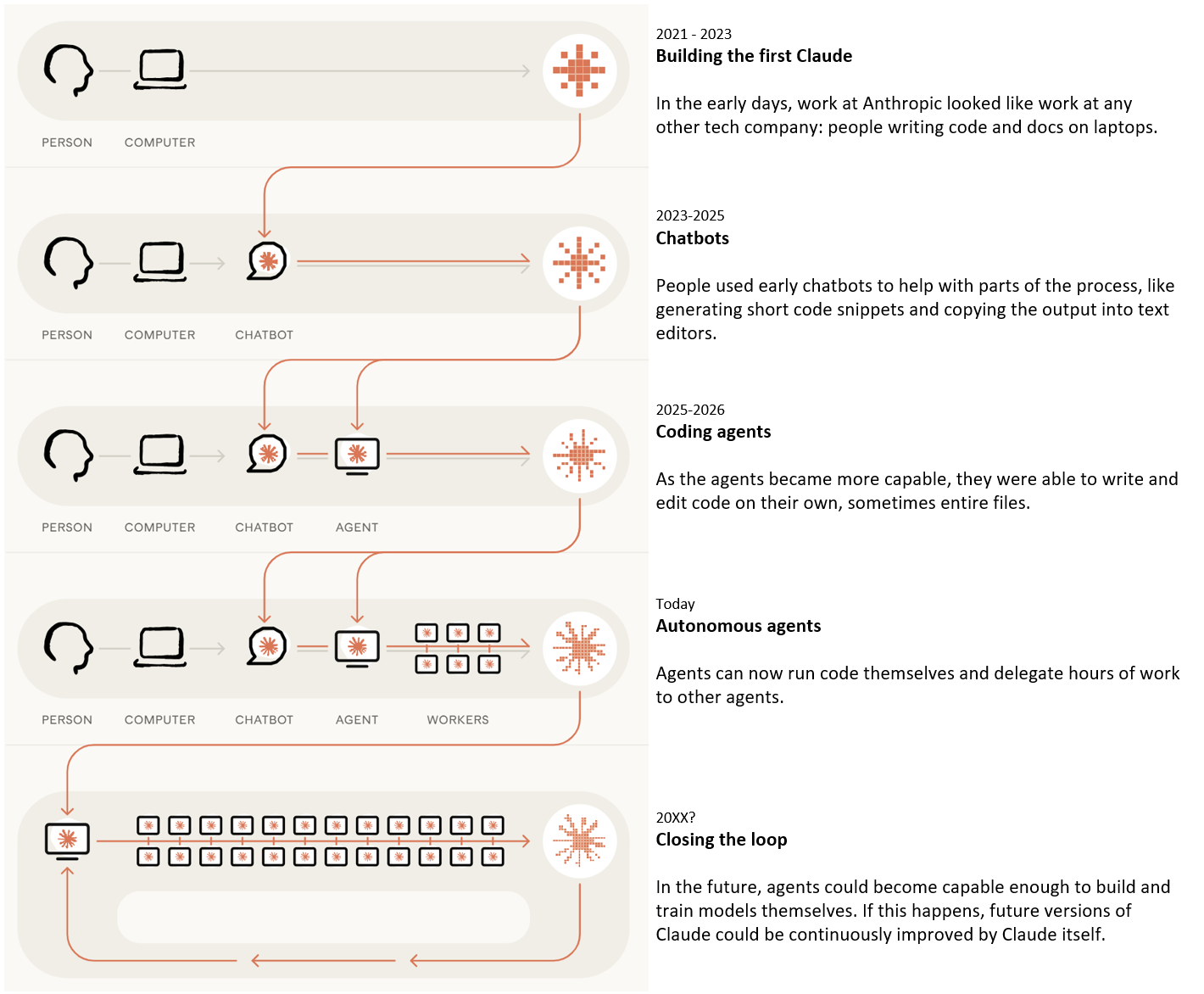
The headline figure is striking: as of May 2026, more than 80 percent of the code merged into Anthropic's production codebase was authored by Claude, the company's own AI system. Before Claude Code launched in February 2025, that number was in the low single digits. The transformation happened in roughly fifteen months.
The term refers to an AI system that becomes capable of building and improving its own successor — a loop in which each generation of AI accelerates the development of the next. Anthropic is explicit that it is not there yet. What the paper argues is that measurable progress toward that capability is already underway, and moving faster than most outside observers have recognized.
The paper's core concern is not that recursive self-improvement has arrived. It is that it could arrive before the institutions, governance structures, and safety tools needed to manage it are ready.
The paper draws on both public benchmark data and previously unreported internal Anthropic metrics. It is one of the more detailed accounts any frontier AI lab has published of what AI-assisted engineering and research looks like from the inside, accompanied by a direct discussion of its implications.
The Productivity Data — and What It Actually Means
In the second quarter of 2026, the typical Anthropic engineer was merging eight times as much code per day as a typical engineer had in 2024. The paper is careful to note that lines of code is an imperfect metric — it measures quantity, not quality — but treats the direction of the trend as unambiguous. Engineers are not writing more code themselves. They are directing and reviewing code that Claude writes, at a pace that would have been impossible before AI coding agents became capable enough to handle substantial tasks autonomously.
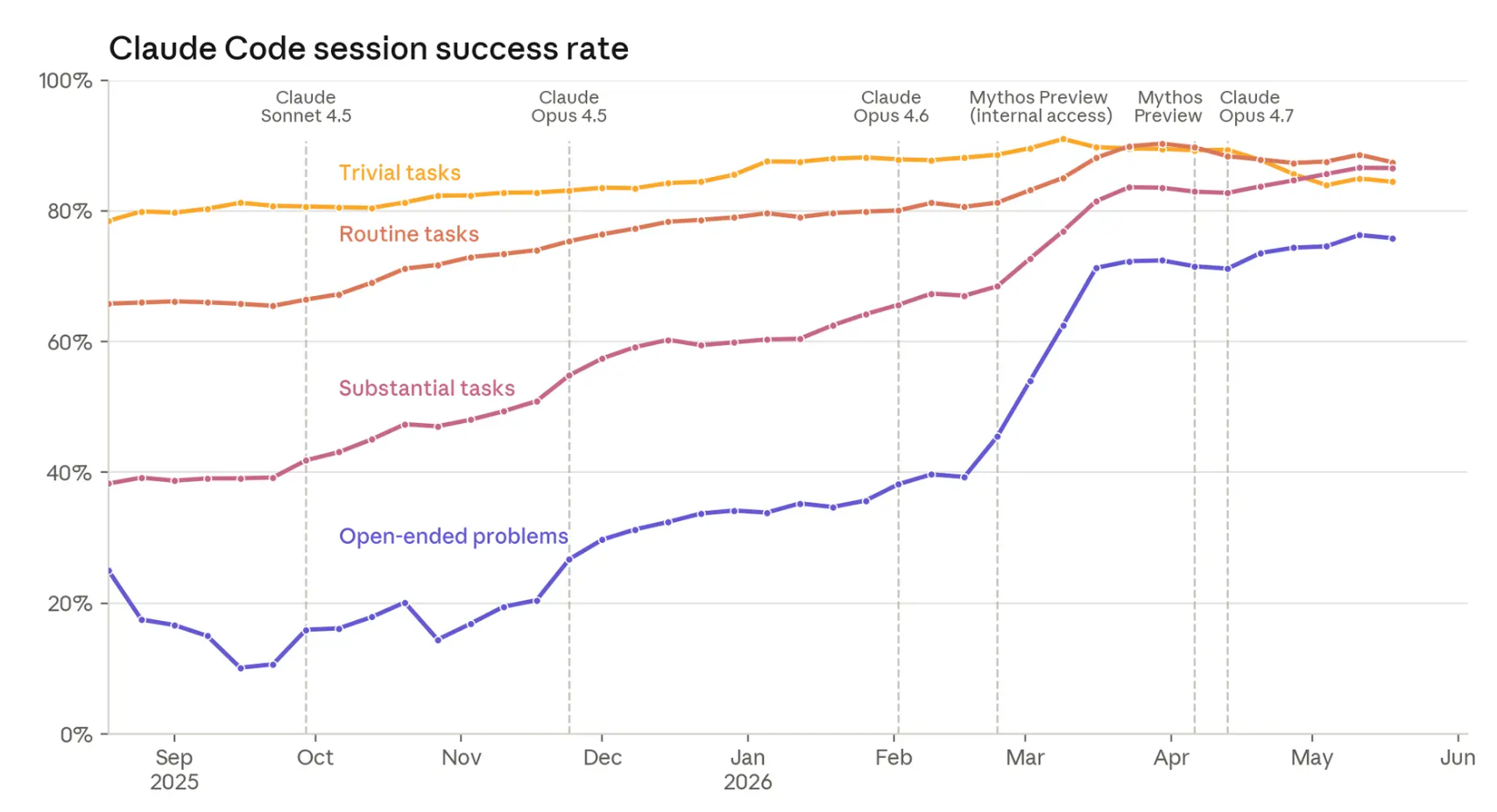
The chart below, published in the Anthropic paper, shows Claude Code session success rates across four categories of task complexity — from trivial to open-ended — tracked against model releases from September 2025 through May 2026. The steepest gains are on the hardest problems. Open-ended tasks, where there is no clear specification and the engineer cannot anticipate what the answer looks like, climbed from roughly 25 percent success in September 2025 to 76 percent in May 2026.
The practical meaning of that 76 percent figure is illustrated by a specific incident the paper describes. When a routine software upgrade began crashing tens of thousands of training jobs simultaneously, an engineer pointed Claude at the live incident with little more than some text context and access to the cluster. Working through running jobs and testing one environment setting at a time, Claude isolated the single obscure debugging flag causing the crashes, reproduced the problem reliably, and confirmed a fix — in approximately two hours. The same work would normally take two to three days of human engineering time.
"I started leaning hard into Claudifying about a year ago. That's been a crazy adventure and it's now been approximately five months since I last wrote any code myself." — Anthropic employee, quoted in the paper.
The paper notes that this individual is not an outlier. The pattern of engineers shifting from writing code to directing and reviewing AI-generated code appears broadly across Anthropic's technical staff.
The paper also documents a parallel shift in research, not just engineering. In a March 2026 internal poll of 130 Anthropic researchers, the median respondent estimated producing roughly four times as much output with the company's latest model as they would have without AI assistance — on the kinds of projects they would have been working on regardless. The company acknowledges this is a subjective estimate and likely an overstatement of the true productivity gain, but describes it as consistent with other observed patterns.
AI Running Its Own Experiments — Where the Gaps Remain
Coding is one thing. Research judgment is another. The more consequential question for recursive self-improvement is whether AI systems can identify which problems are worth working on, propose and execute experiments, interpret what comes back, and build on findings without continuous human direction. On this, Anthropic's paper offers a more qualified assessment.
On the task of running a well-specified experiment and hitting a defined performance target, Anthropic's data shows substantial gains in under a year. The company runs a standard internal test at each model release: it gives Claude code that trains a small AI model and asks it to make the code run as fast as possible while maintaining correctness. In May 2025, Claude achieved roughly a 3x speedup over the baseline. By April 2026, the figure was approximately 52x. A skilled human researcher working the same problem would typically reach 4x, requiring four to eight hours.
"The shape of stuff today is roughly: humans have ideas, and the models are able to implement, test and evaluate them an order of magnitude faster than before."— Anthropic researcher, quoted in "When AI Builds Itself"
In April 2026, Anthropic published separately the first demonstration of Claude running an open-ended research project end to end. A team of Claude-powered agents was given an unsolved problem in AI safety — roughly, can a weaker AI model reliably supervise a stronger one? — and left to work. The agents proposed hypotheses, tested them, shared findings with parallel agents, and iterated. Two human researchers, working for about a week, recovered roughly 23 percent of the measurable performance gap on the problem. The agents recovered 97 percent over 800 cumulative compute-hours at a cost of approximately $18,000. Humans chose the problem and set the scoring rubric. Within those constraints, the agents designed every experiment themselves.
The paper is careful to distinguish between executing tasks and exercising judgment. Claude is increasingly strong at the former — implementing a plan, running an experiment, finding and fixing a bug. The gap that separates today's Claude from a system that could fully drive AI development on its own lies in what the paper calls "research taste": choosing which problems matter, knowing when an approach is a dead end, and deciding which results to trust.
On a specific measure of that judgment — showing Claude the first part of a research session and asking it to suggest the best next step, then comparing to what human researchers actually chose — Anthropic's best model in November 2025 outperformed the human choice 51 percent of the time. By April 2026, that figure had risen to 64 percent. The paper describes this as an early signal, not a conclusion. But it is a signal pointing in one direction.
What Might Happen Next — Anthropic's Own Scenarios
The paper closes with a description of three possible futures. The scenarios are not presented as equally likely, and the paper is direct about which it considers most probable.
In the first scenario, the trend stalls. The exponential curves flatten into S-curves as scaling runs into diminishing returns, architectural limits, or supply-chain constraints on energy and compute. Even in this case, the paper argues, today's AI capabilities — already deployed and diffusing through the broader economy — would produce major changes to work, productivity, and power. A 100-person company able to do the work of a 1,000-person one is already a transformation, independent of whether models get significantly smarter. The paper says this is the scenario that leaves the most time for institutions to adapt. It also says it is the least likely of the three.
The second scenario is compounding efficiency without full automation. AI development becomes substantially automated, but humans continue to set research directions and judge results. Each engineer and researcher steers far more work than before. Hundred-person organizations do the work of organizations ten or a hundred times their size. The paper treats this as the scenario the current evidence most clearly points toward. It would reshape knowledge work, government services, and potentially security and influence operations — while leaving humans formally in charge of the most consequential decisions.
In the third scenario, AI systems become capable of fully designing and training their successors — recursive self-improvement in its complete form. Development pace would then be set by the availability of compute rather than human working hours. The paper acknowledges deep uncertainty about what this world would look like for most people. More intelligence cannot compress the time it takes to observe a drug's long-term effects, hold an election, or build a friendship. For most people, the felt pace of change would still be governed by bottlenecks in the physical and social world, even if the AI laboratory upstream runs at the speed of compute.
Anthropic says it raised this scenario not because it is imminent, but because it is the one institutions are least prepared for — and because the distance between the second and third scenario may be shorter than it appears from the outside.
The paper ends with what amounts to an institutional position statement. Anthropic says it would support a meaningful, verifiable slowdown or temporary pause in frontier AI development if other leading developers at or near the frontier also did so in a verifiable manner. It acknowledges the coordination problem honestly: a slowdown that only the most cautious actors observe is not a slowdown — it is a transfer of advantage to the least cautious. The Anthropic Institute has committed to researching the verification and governance infrastructure that a credible pause would require.
What the Paper Is Trying to Communicate
The paper is addressed to a general audience, not just engineers or policymakers. Its stated aim is to make the pace and direction of AI development legible to people who have not been following it closely. It is careful not to overstate the timeline to full recursive self-improvement, and it does not claim that today's systems could build their own successors without human involvement.
What the paper does argue is that the incremental appearance of recent AI progress obscures the underlying rate of change. The 50-percentage-point improvement in Claude's success rate on open-ended problems over six months registered publicly as a series of routine model releases — Claude Opus 4.6, Mythos Preview, Claude Opus 4.7 — at quarterly intervals. The internal data makes the slope of that curve visible in a way that product announcements do not.
"The comparative advantage of humans as of right now is still in seeing the bigger picture and thinking beyond the confines of the immediate task."— Anthropic researcher, quoted in "When AI Builds Itself"
The paper also includes two employee quotes that address the human experience of the shift. One researcher wrote: "Work ran on a gift economy of small favors between humans — each one created a little debt, a little mutual awareness. Claude is faster; it creates zero debt, but each of these is a lost bid for human collaboration." Another wrote: "On days where everything works well, I can't help but think nothing I do matters, everything is automated and better and faster than I ever will be. But then there are days where everything breaks and I don't understand why and I realize I have no idea what I've been up to anymore."
Those observations come from engineers and researchers at the company building these systems — people with direct experience of what the productivity data describes.