
The question that triggered this discussion
During a student Q&A at Georgetown University, a student named Dia raised a practical concern that many communities are now facing.
Dia is a senior originally from the Mississippi Delta. She noted that Mississippi has signed multiple contracts with large companies to build AI data centers as a form of economic development. Her question was how communities should balance the promise of investment and jobs with rising energy costs, water use, and environmental concerns being felt by residents.
This question led to an exchange between Senator Bernie Sanders and AI researcher Geoffrey Hinton that revealed something deeper than a simple “pro versus con” debate.
Bernie Sanders: why communities are pushing back
Senator Sanders emphasized that many communities are already rejecting new data centers, not because they oppose technology, but because they are being asked to absorb the costs while receiving few of the benefits.
He pointed out that data centers consume enormous amounts of electricity and water. In many cases, local residents see their electric bills rise as utilities expand generation and transmission to serve corporate facilities. At the same time, automation can reduce local employment, leading people to ask why they should pay higher power and water costs while losing jobs.
Sanders also stressed that large corporations often push these projects through despite local opposition, using their economic and political influence. He described this as a live political issue already affecting states like Virginia, where voters are connecting higher electricity rates to rapid data center expansion.
Geoffrey Hinton: a different way to think about the problem
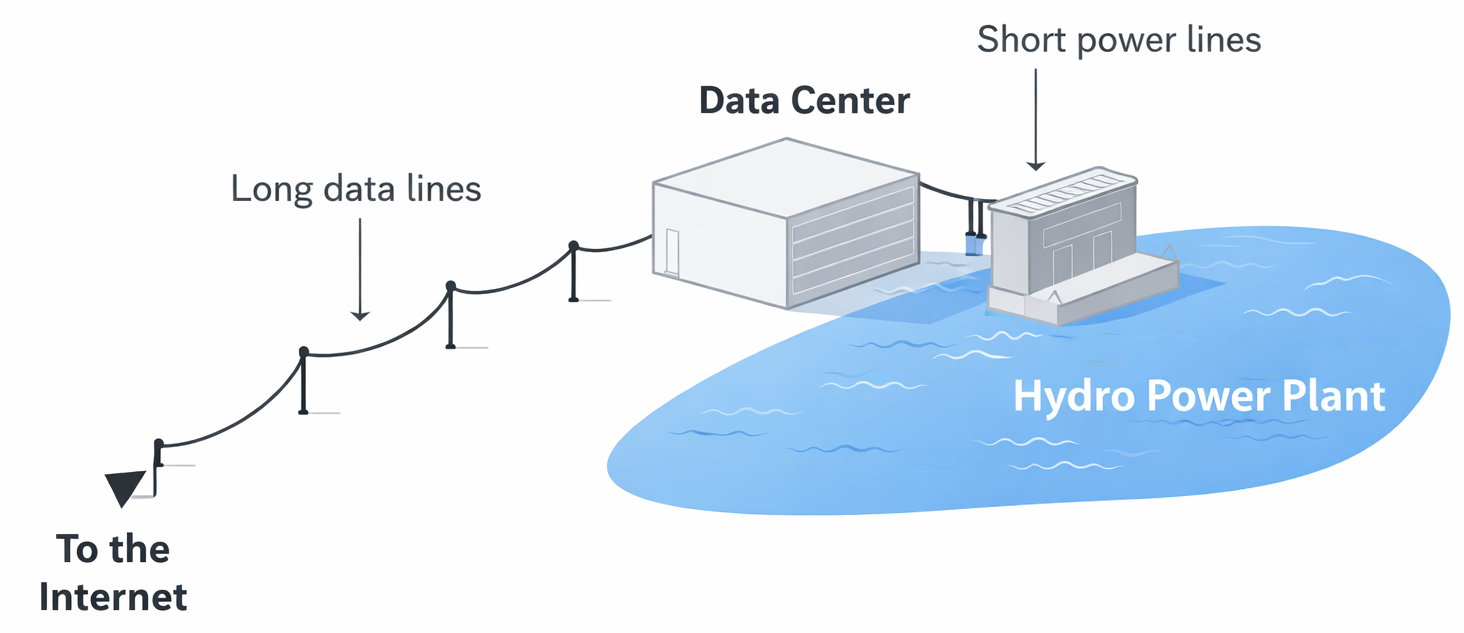
Geoffrey Hinton added a less familiar but crucial systems insight. His argument was not just about regulation, but about geography.
Electricity is difficult, expensive, and politically contentious to move long distances. New transmission lines take years to approve, face local resistance, and often raise rates for surrounding communities.
Data, by contrast, is easy to move. Once computation is completed, the results can be sent over fiber-optic networks with relatively little energy cost.
Because of this imbalance, Hinton suggested that large AI data centers should be built near abundant, low-carbon sources of electricity, rather than near population centers. He used the Hudson Bay region as an example because it has significant untapped hydroelectric potential and a cold climate that can help reduce cooling demands.
In this model, the power plant and the data center sit close together, connected by a short power line. Instead of building long transmission lines to cities, only information needs to travel long distances, and that can be done efficiently over existing internet infrastructure.
Hinton noted that he had discussed this idea with Canada’s prime minister, underscoring that this was not a casual remark but a serious alternative approach to AI infrastructure.
Why this matters
Together, Sanders and Hinton framed the issue as both political and technical.
Sanders focused on who pays the costs and who benefits when data centers are dropped into local communities. Hinton focused on whether those conflicts are partly self-inflicted by building infrastructure in the wrong places.
If data centers are located near abundant clean power instead of near population centers, communities may face fewer rate increases, less water stress, and fewer environmental conflicts. At the same time, AI systems can still serve users globally, because information is far easier to move than electricity.
The core insight is simple but powerful: ship the bits, not the electrons.
The bigger question
Dia’s question ultimately points to a larger issue. AI infrastructure choices are not inevitable facts of nature. They reflect decisions about who bears costs, who captures benefits, and whether systems are designed for efficiency or convenience.
Where AI data centers are built will shape energy systems, local economies, environmental impacts, and political tensions for decades. Treating location as a technical afterthought rather than a core design choice risks repeating the same conflicts again and again.